


blog : November 2012
We Learn Best in Pictures
11/13/2012
 For today’s classroom, nothing is more essential to successful teaching and learning than strategy-based
instruction. It is through the use of specific teaching strategies and learning tools that students can be
more successful learners. Graphic organizers are teaching and learning tools; when they’re integrated
into classroom experiences, students are better able to understand new material. Brain and learning
research documents the reality that we actually learn through pictures and graphic representations.
Creating a strong visual picture, graphic organizers support students by enabling them to literally see
connections and relationships between facts, information, and terms.
For today’s classroom, nothing is more essential to successful teaching and learning than strategy-based
instruction. It is through the use of specific teaching strategies and learning tools that students can be
more successful learners. Graphic organizers are teaching and learning tools; when they’re integrated
into classroom experiences, students are better able to understand new material. Brain and learning
research documents the reality that we actually learn through pictures and graphic representations.
Creating a strong visual picture, graphic organizers support students by enabling them to literally see
connections and relationships between facts, information, and terms.
When we integrate graphic organizers in our teaching, we are actively engaging a wide variety of
learners, including students with special needs and English language learners. Since the human brain
naturally organizes and stores information, graphic organizers are a supportive strategy for learning.
Graphic organizers lead to strong visualizations of mental storage systems and serve to support students
to remember and connect information. Once this is accomplished, students can delve into more critical
information. Graphic organizers actually trigger long term memory and promote synthesis between old
and new information.
Here are some tips for classroom implementation of graphic organizers:
- Model the graphic organizer when you present it to the class. Model how you learn and think as you use a graphic organizer to understand material.
- Graphic organizers can be used in both individual and group learning experiences. In both contexts, the graphic organizer provides a structure for students to think about new material.
- Assessment should be reliable and varied. Graphic organizers can be easily used for classroom assessment in lieu of a more traditional quizzes and tests. Graphic organizers are superior to quizzes and tests because it also provides a picture into a student’s thinking.
In addition, graphic organizers are particularly beneficial for students with special needs. Many students
with special needs face difficulties in decoding and comprehending text and developing vocabulary. This
makes reading and learning even more challenging for these students. Here are some suggestions of
how you can adapt and differentiate graphic organizers to meet the needs of diverse learners:
- Physically divide some of the organizers by cutting, folding, or highlighting different sections. This helps the students focus on one section and activity at a time.
- Use a highlighter or different colors for the graphic organizer headings to help students process and focus on key information.
- Have students work in pairs or in small groups, as needed. Students who have difficulty with attention and reading will benefit from working with their peers. Working in a social setting helps all students to work collaboratively and to take responsibility for their own learning.
- Create reading frames for students. Using heavy card stock or cardboard, create frames of different sizes so that students can place them over sections. This helps students focus on one section at a time.
Remember, there is never ONE right way to visually represent information. Your students may be
exposed to many kinds of graphic organizers. Some students are more visually oriented than others so
there will be a range in student work.
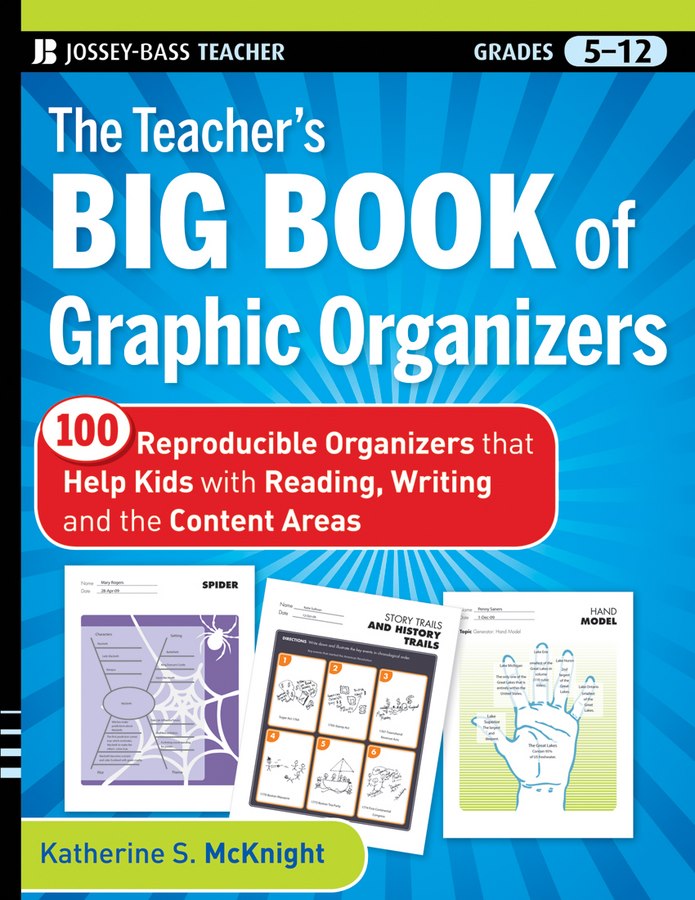
Finally, my book, The Teacher's Big Book of Graphic Organizers: 100 Reproducible Organizers that
Help Kids with Reading, Writing, and the Content Areas is a valuable resource for graphic organizers.
There are templates for over 100 graphic organizers with student samples and tips for classroom
implementation.

April 2015 : 2 posts
March 2015 : 0 posts
February 2015 : 0 posts
January 2015 : 0 posts
December 2014 : 1 post
November 2014 : 4 posts
October 2014 : 5 posts
April 2015 : 2 posts
March 2015 : 0 posts
February 2015 : 0 posts
January 2015 : 0 posts
December 2014 : 1 post
November 2014 : 4 posts
April 2015 : 2 posts
March 2015 : 0 posts
February 2015 : 0 posts
January 2015 : 0 posts
December 2014 : 1 post
November 2014 : 4 posts
October 2014 : 5 posts
September 2014 : 7 posts
August 2014 : 3 posts
July 2014 : 0 posts
June 2014 : 2 posts
May 2014 : 0 posts
April 2014 : 1 post
March 2014 : 1 post
February 2014 : 0 posts
January 2014 : 2 posts
December 2013 : 0 posts
November 2013 : 6 posts
October 2013 : 0 posts
September 2013 : 1 post
August 2013 : 0 posts
July 2013 : 5 posts
June 2013 : 5 posts
May 2013 : 6 posts
April 2013 : 2 posts
March 2013 : 9 posts
February 2013 : 4 posts
January 2013 : 8 posts
December 2012 : 2 posts
November 2012 : 12 posts
October 2012 : 6 posts
September 2012 : 3 posts
August 2012 : 0 posts
July 2012 : 4 posts
June 2012 : 3 posts
May 2012 : 3 posts
April 2012 : 8 posts
March 2012 : 4 posts
February 2012 : 3 posts
January 2012 : 8 posts
December 2011 : 0 posts
November 2011 : 7 posts
October 2011 : 5 posts
September 2011 : 2 posts
August 2011 : 1 posts
July 2011 : 15 posts
June 2011 : 16 posts
May 2011 : 0 posts
April 2011 : 2 posts
March 2011 : 8 posts
February 2011 : 3 posts
January 2011 : 7 posts
December 2010 : 3 posts
November 2010 : 12 posts
October 2010 : 10 posts
September 2010 : 10 posts
August 2010 : 0 posts