


blog : January 2013
Speed Date: Reading Strategies
1/17/2013
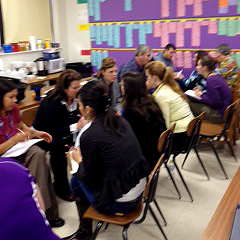 Last week I worked with my teacher friends at George Washington Community High
School in Indianapolis, IN. For the past 20 months we shared a tremendous amount
of knowledge and it was definitely time to catalogue all that we know. Recently, the
teachers prioritized reviewing and sharing the interdisciplinary literacy strategies.
In order to accomplish the cataloguing of their vast knowledge, I introduced “speed
dating” to the faculty during the professional learning committee (PLC) meetings
last week. Here are step-by-step directions for “speed dating” as a teaching and
learning strategy that can also use with your students.
Last week I worked with my teacher friends at George Washington Community High
School in Indianapolis, IN. For the past 20 months we shared a tremendous amount
of knowledge and it was definitely time to catalogue all that we know. Recently, the
teachers prioritized reviewing and sharing the interdisciplinary literacy strategies.
In order to accomplish the cataloguing of their vast knowledge, I introduced “speed
dating” to the faculty during the professional learning committee (PLC) meetings
last week. Here are step-by-step directions for “speed dating” as a teaching and
learning strategy that can also use with your students.
 Step One: Instruct the participants to sit opposite each other chairs (or desks) Like
this:
Step One: Instruct the participants to sit opposite each other chairs (or desks) Like
this:
I have as many as 20 participants in the rows. If you have a large group, create
several groups.
Step Two: Instruct the participants that they will share their information with the
person directly across from their seat. Give the students a specific amount of time
to share information. Once the allotted time is complete, instruct the students that
they will all move to the left, one seat. For students, I always give them a countdown
as they switch seats.
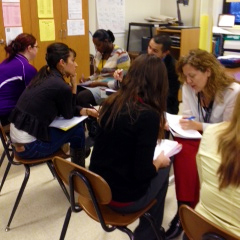 Step Three: Once the students have switched seats, they should repeat the process
in step two.
Step Three: Once the students have switched seats, they should repeat the process
in step two.
Struggling adolescent readers need the reading process broken down so that they
can develop a strategy toolbox. Consequently, we decided that for this session,
we would focus on “making thinking visible” strategies. Making Thinking Visible
Strategies provides students with the means to develop their comprehension of a
text when they are faced with challenging reading. We shared a ton of information.
The chart below was developed through the following sources: The Teachers Big
Book of Graphic Organizers and the George Washington Community School Faculty
(Indianapolis, IN).
| Strategy | What is it? |
| Annotated Think Aloud | Students are prompted to underline important information from the text and provide a written or oral explanation. |
| Anticipation Activity |  Create posters with controversial statements that relate to the new content/text. Students are given 3 sticky notes and may choose to agree/disagree with each statement. Here’s a diagram of the poster:
|
| Equations Photo Booth | Student pairs write one step of an equation at a time on a whiteboard and take a picture of themselves. End result--- a photo strip detailing the solution steps. |
| Foldable: 3-D Graphic Organizers | Graphic organizers constructed from paper, cardboard, etc. |
| Gallery Walk | Using pictures, other visuals, and text, students examine these artifacts and take notes prior to reading. This activity builds schema for the new material. |
| Graphic Organizers | Visual organizations of material and concepts. Graphic organizers support learners to analyze, synthesize, and connect new information. |
| Guided Reading Study Guide | At the beginning of a chapter or unit, the students preview the text and material. Once the students have previewed the text and material, they will create questions that should be answered as they progress through the text/material. |
| KWL |
Created by Donna Ogle, the KWL strategy is a three-column chart that
captures the before, during, and after stages of reading. K = What a reader already knows about the selected text topic. Students tap into their prior knowledge before they begin reading. As we know from research in reading, prior knowledge supports student comprehension. W = What a student wants to know about the selected text topic. Students’ asking questions before they read a text also supports their comprehension. L = What the students learned about the topic. Students’ reflecting and thinking about what they just read aids them in their ability to synthesize newly acquired information with prior knowledge. |
| Models | Students build models for concepts such as a DNA strand. |
| MTV-Making Thinking Visible | Independently read a “meat” paragraph and draw a picture to represent the reading. Use examples to relate details in the picture to the reading. |
| Predict Before You Begin | Students preview material and develop predictions. |
| Pictorial Schedule | Create a schedule that uses pictures. This is also great for students whose first language is not English. Accompany the pictures with text. |
| Question Answer Relationship |
Strategy invented by Taffy Raphael QAR teaches students how to decipher what types of questions they are being asked and where to find the answers to them. Four types of questions are examined in the QAR. |
| Question Around | Taking turns, students answer questions that they pose. |
| Request | Student directed questioning technique that promotes close reading. |
| Rhythmic/Melodic Diction | Students are given a section of music to sight read and are prompted to listen to the passage and provide notations. |
| Role Play | Students act out key events. |
| Sticky Notes | A method for students to keep a written record of what they see and hear when they’re reading. |
| Sticky Note Jigsaw | Students are assigned to read 2-3 paragraphs. Students record comments, questions, connections (similar to sticky notes strategy) on sticky notes. Then students post their sticky notes to key idea posters. Once the students post their sticky notes on the corresponding topic posters, they examine all of the sticky notes through a gallery walk. |
| Sticky Note Theme Search | The students are given a theme or large idea and as the students read through the text and new content information, they will record on sticky notes information connected to the them or major idea. |
| Story Boards/Story Trails | Offers a structure for students to sequence events or steps. |
| Think Alouds | When teachers model the Think Aloud strategy, they discuss how good readers make meaning of a text. |
| Think Aloud Translating (Student-led) | The students translate challenging text into “real words.” |
| Think-Pair-Share | Think-Pair-Share (TPS) is a collaborative learning strategy in which students work together to solve a problem or answer a question about an assigned reading. This technique requires students to (1) think individually about a topic or answer to a question; and (2) share ideas with classmates. Discussing an answer with a partner serves to maximize participation, focus attention and engage students in comprehending the reading material. |
| Think Aloud Translating (Student-led) | The students translate challenging text into “real words.” |
| Three Column Organizer |
Use the following organizer for this activity:
|
| Varied Text | Use pictures to explain a concept or skill. For example, students will examine various pictures and identify the type of conflict (i.e. man vs. man, man vs. fate, and so on) |
April 2015 : 2 posts
March 2015 : 0 posts
February 2015 : 0 posts
January 2015 : 0 posts
December 2014 : 1 post
November 2014 : 4 posts
October 2014 : 5 posts
April 2015 : 2 posts
March 2015 : 0 posts
February 2015 : 0 posts
January 2015 : 0 posts
December 2014 : 1 post
November 2014 : 4 posts
April 2015 : 2 posts
March 2015 : 0 posts
February 2015 : 0 posts
January 2015 : 0 posts
December 2014 : 1 post
November 2014 : 4 posts
October 2014 : 5 posts
September 2014 : 7 posts
August 2014 : 3 posts
July 2014 : 0 posts
June 2014 : 2 posts
May 2014 : 0 posts
April 2014 : 1 post
March 2014 : 1 post
February 2014 : 0 posts
January 2014 : 2 posts
December 2013 : 0 posts
November 2013 : 6 posts
October 2013 : 0 posts
September 2013 : 1 post
August 2013 : 0 posts
July 2013 : 5 posts
June 2013 : 5 posts
May 2013 : 6 posts
April 2013 : 2 posts
March 2013 : 9 posts
February 2013 : 4 posts
January 2013 : 8 posts
December 2012 : 2 posts
November 2012 : 12 posts
October 2012 : 6 posts
September 2012 : 3 posts
August 2012 : 0 posts
July 2012 : 4 posts
June 2012 : 3 posts
May 2012 : 3 posts
April 2012 : 8 posts
March 2012 : 4 posts
February 2012 : 3 posts
January 2012 : 8 posts
December 2011 : 0 posts
November 2011 : 7 posts
October 2011 : 5 posts
September 2011 : 2 posts
August 2011 : 1 posts
July 2011 : 15 posts
June 2011 : 16 posts
May 2011 : 0 posts
April 2011 : 2 posts
March 2011 : 8 posts
February 2011 : 3 posts
January 2011 : 7 posts
December 2010 : 3 posts
November 2010 : 12 posts
October 2010 : 10 posts
September 2010 : 10 posts
August 2010 : 0 posts